
Church Leaders: 5 Real Differences Between Mentoring and Discipleship


Mentoring and discipleship overlap, but they are not the same thing. Mentoring is a human led process that develops a particular skill, role or season of life. Discipleship is Jesus centred and Spirit led, aimed at whole life transformation and obedience to Christ. Both have real value, and the wisest churches use each one deliberately rather than treating them as synonyms.
TL;DR:
Mentoring focuses on skill development with a clear start and end, while discipleship seeks lasting transformation and reproduces in others over a lifetime.
Mentoring is driven by the mentee’s goals and can occur between people of any belief, whereas discipleship is Christ-centered, Spirit-led, and rooted in obedience to Jesus.
Effective mentoring often results in improved competence but may not impact spiritual depth, while discipleship aims for deep character change and lifelong reproducibility.
Most relationships benefit from a combination of both, with discipleship usually requiring more vulnerability and longer-term commitment than mentoring.
Success in discipleship is measured by whether the disciple reproduces and makes further disciples, unlike mentoring which primarily measures goal achievement.
Table of Contents
Mentoring vs discipleship: clear definitions to start with
Mentoring is a relationship where someone with more experience helps another person grow in a defined area, a career, a leadership skill, a season of parenting or study. The mentee usually sets the agenda. The mentor offers wisdom, feedback and encouragement, often for a fixed purpose and a limited stretch of time.
Discipleship is different in kind, not just degree. It flows from the Great Commission in Matthew 28:19 to 20, where Jesus commands his followers to make disciples, teaching them to obey everything he commanded. Discipleship is Christ centred and Spirit led rather than agenda driven by the individual, and it touches the whole of life, not a single skill set. Mentoring is a human driven process, while discipleship is a Jesus centred, Spirit led mandate aimed at holistic transformation and conformity to Christ.
A few working distinctions worth holding onto:
Mentoring often has a start and end date tied to a goal.
Discipleship is meant to continue for life, reproducing in others.
Mentoring can happen between two people of any belief background.
Discipleship is rooted in following Jesus specifically, obeying his teaching and being shaped by Scripture.
Core differences: five axes worth comparing
Once you have the definitions straight, the practical differences become easier to spot. Here are the five that matter most when you are deciding how to invest in someone.
Aim and ultimate goal. Mentoring aims at competence, mentoring someone into a skill, a role or a life stage. Discipleship aims at conformity to Christ, a deeper and slower goal that touches character, worship and obedience.
Authority and agenda. In mentoring, the mentee typically drives the agenda and the mentor responds to stated needs. In discipleship, Scripture and the person of Christ set the agenda, and the discipler helps someone submit to that authority rather than their own preferences.
Scope. Mentoring usually covers a slice of life, work, ministry skill or a specific challenge. Discipleship is whole of life. It touches finances, relationships, suffering, ambition and identity because it is concerned with who a person is becoming, not just what they can do.
Methods and typical content. Mentoring often uses goal setting, feedback loops and skill practice. Discipleship leans on Scripture reading, prayer, confession and practical obedience, worked out in ordinary relationship rather than a training curriculum.
Outcomes and measurement. A mentoring relationship succeeds when the mentee reaches a defined goal. Discipleship succeeds when the disciple grows in Christlikeness and, crucially, when discipleship multiplies by going on to disciple someone else.
Pro Tip: If you are only measuring whether someone hit a personal goal, you are running a mentoring relationship. If you are asking whether they are ready to disciple someone else, you are doing discipleship.
What mentoring and discipleship share
The two relationships look remarkably similar from the outside. Both involve one to one time, honest listening, and a willingness to speak into someone’s life without pretending to have all the answers. That overlap is why the terms get confused so often, and why churches sometimes run discipleship programs that are really just mentoring with a Bible verse attached.
Christian mentoring relationships lean on listening, scriptural wisdom, prayer support and accountability, and mentors are wise to know their limits, referring anything resembling counselling to trained professionals rather than working beyond their depth. Discipleship shares every one of those practices, prayer, presence, honest accountability, but adds a Christ centred purpose underneath them.
A few shared habits worth naming:
Regular one to one time, ideally weekly or fortnightly.
Active listening before offering advice or correction.
Modelling a way of life, not just giving instructions.
Honest accountability, including the freedom to ask hard questions.
The shared danger is mentor idolisation, where the person being mentored starts following the mentor’s opinions more closely than Christ’s teaching. Guard against it by pointing back to Scripture constantly, and by being honest about your own ongoing growth rather than posing as a finished product.
How to decide: mentoring, discipleship or both?
Not every relationship needs the same shape. A university student wanting help with public speaking probably needs mentoring. A new believer wanting to understand what it means to follow Jesus needs discipleship. Many people need both running side by side.
A useful screening tool comes from the Navigators, who describe readiness through three qualities known as FAT: Faithful, Available, Teachable. Someone who shows up consistently, has genuine capacity in their schedule and responds well to correction is ready for the deeper investment discipleship requires.
Before you commit, ask a few clarifying questions:
What outcome is this person hoping for, and is it a skill or a life transformation?
How much time can they realistically give each week?
Are they open to Scripture setting the agenda, or do they want a purely practical arrangement?
Pro Tip: When someone asks for mentoring but keeps raising questions about faith, identity or purpose, that is often a sign they are ready for discipleship, even if they haven’t used the word.
As a rough pairing, a quick skill gap, resume feedback, a leadership technique, calls for mentoring. New believers, people rebuilding their faith, or anyone wanting whole life growth call for discipleship.
How to start and structure the relationship
Both mentoring and discipleship work best when they begin with clarity rather than good intentions alone. Vague arrangements drift. Clear ones last.
Have an honest first conversation. Talk through expectations, confidentiality, how often you will meet and what each person is responsible for bringing to the table.
Set a defined length. Practitioners commonly recommend 8 to 12 week discipling cycles, which gives enough time for real change without becoming an open ended, directionless commitment.
Use a simple session structure. A workable discipling meeting runs roughly 15 to 20 minutes on life and prayer check in, 30 to 40 minutes in Scripture study, and 10 to 15 minutes on application and accountability.
Write a one page plan for mentoring. Note the goal, the timeframe, and two or three review points so both people know what progress looks like.
Know when to refer on. If conversations move into trauma, addiction, or serious mental health concerns, refer to pastoral staff or a qualified counsellor rather than trying to carry it alone.
Practical disciplemaking meetings often include prayer, Scripture reading and shared ministry or service, which keeps the relationship from becoming purely academic. Discipleship stays relational and repetitive by design, not a course to complete and move on from.
How Divergent Church approaches discipleship
At Divergent Church, discipleship is not a side program. It is the shape of the whole community, worked out through the Discipleship Hub, our central pathway for helping people follow Jesus in ordinary, everyday life across Canberra and Queanbeyan.
Pathways are built for ordinary believers to disciple others, not just for trained specialists.
Practical tools, including discipleship questions, support real conversations rather than generic check ins.
Life Communities or small groups can give discipleship a home outside Sunday gatherings, in homes, workplaces and neighbourhoods.
Where mentoring and discipleship come from
Mentoring as a concept traces back to Ancient Greece, where the character Mentor in Homer’s Odyssey guided Telemachus in his father’s absence. It became a formalised idea in trades and professions over centuries, apprentices learning craft from a master, and later spread into business and leadership development as a secular, results focused practice.
Discipleship has a different lineage entirely. It comes from the rabbi and talmid relationship in first century Judaism, where a disciple did not just learn a teacher’s content but adopted their entire way of life, walking, eating and living alongside them. Jesus took that existing cultural pattern and filled it with new meaning, calling twelve ordinary men to follow him, watch him, and eventually carry his mission forward themselves.
That historical difference still shapes the two practices today. Mentoring inherited a professional, outcome focused culture built on transferring expertise. Discipleship inherited a whole of life, apprenticeship culture built on transferring identity and obedience, not just information. Understanding that history helps explain why discipleship resists being reduced to a curriculum. It was never meant to be a course. It was meant to be a shared life, which is part of why churches that treat discipleship like a six week class often see it fade once the class ends.
What mentors and disciplers are actually responsible for
A mentor’s core responsibility is competence transfer. That means giving honest feedback, sharing relevant experience, and holding the mentee accountable to goals the mentee themselves set. A good mentor knows the edges of their role. They are not a counsellor, a pastor or a parent substitute, and the strongest mentoring relationships stay inside that lane deliberately.
A discipler carries a broader and heavier responsibility. Their job is to model a life following Jesus, not just to transmit information about him. That includes praying with and for the person they are discipling, opening Scripture together, and being willing to talk about the discipler’s own failures and growth areas. You do not need to be a finished, polished believer to disciple someone. Discipleship is about passing on what you have received with honesty, not projecting spiritual perfection you do not possess.
Both roles carry a duty of care. Christian mentors are expected to recognise when a conversation has moved beyond their competence and refer it to a professional, particularly around mental health or trauma. Disciplers carry that same duty, plus an added one: helping the person they disciple identify who they, in turn, might disciple. A discipler who never raises that question has stopped short of the role’s full responsibility. The measure of good discipling is never just how the disciple is doing. It is also whether they are starting to reproduce what they have received.
What effective mentoring and discipleship look like in practice
Picture a young professional struggling to lead her first team. A mentor at her church spends six months walking her through delegation, difficult conversations and time management, meeting fortnightly over coffee with a clear goal in mind. Within half a year, she is leading with noticeably more confidence. That is mentoring doing exactly what it is built for, bounded, skill focused, successful on its own terms.
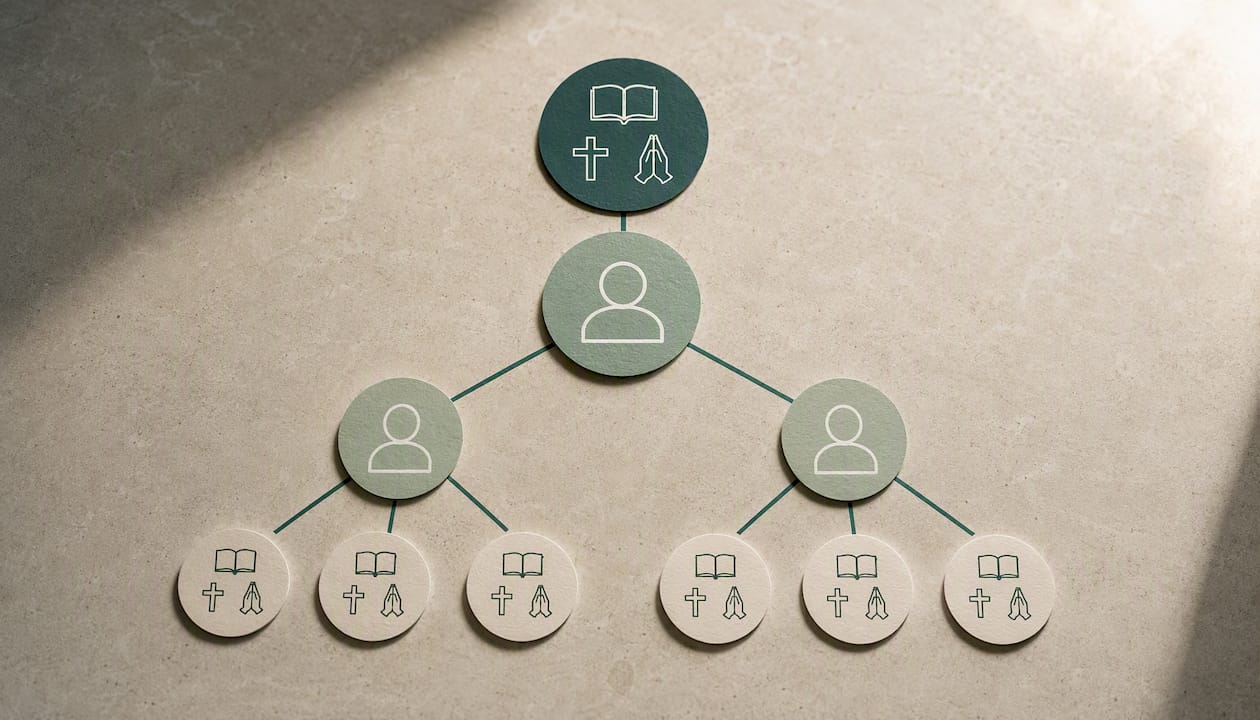
Now picture a new believer who has just started attending a Life Community. Rather than being handed a book list, he is paired with someone slightly further along who meets him weekly for coffee, walks through a passage of Scripture, prays with him, and asks how he is going with actually applying it. Eighteen months later he is leading his own small conversation with two newer believers. That is discipleship doing what it is built for, unbounded in time, whole of life in scope, and multiplying rather than simply completing.
The clearest case studies of effective discipleship almost always include this multiplication marker. A discipling relationship that produces a competent, confident individual who never disciples anyone else has succeeded at mentoring’s goal, but fallen short of discipleship’s. The reverse case, someone who reproduces the process in someone else within a year or two of being discipled themselves, is the strongest evidence a discipling relationship has actually worked.
Benefits and challenges: mentoring compared with discipleship
Mentoring’s biggest strength is its clarity. A defined goal, a bounded timeframe and a measurable outcome make it easy to know whether the relationship succeeded. It is also low commitment, which makes it accessible to busy professionals and easier for churches to resource at scale. Its main limitation is depth. Mentoring can build a better leader without touching the state of that person’s soul, and a mentoring relationship that never moves toward Christ can leave someone competent but spiritually stagnant.
Discipleship’s biggest strength is its depth and durability. Because it touches identity rather than just skill, the growth tends to hold under pressure in a way surface level coaching often does not. Its central challenge is exactly the flip side of mentoring’s strength: it resists tidy measurement. You cannot always point to a finish line, and that ambiguity frustrates people used to KPIs and clear milestones. Discipleship also demands more vulnerability from the discipler, who has to admit their own ongoing struggles rather than presenting polished expertise.
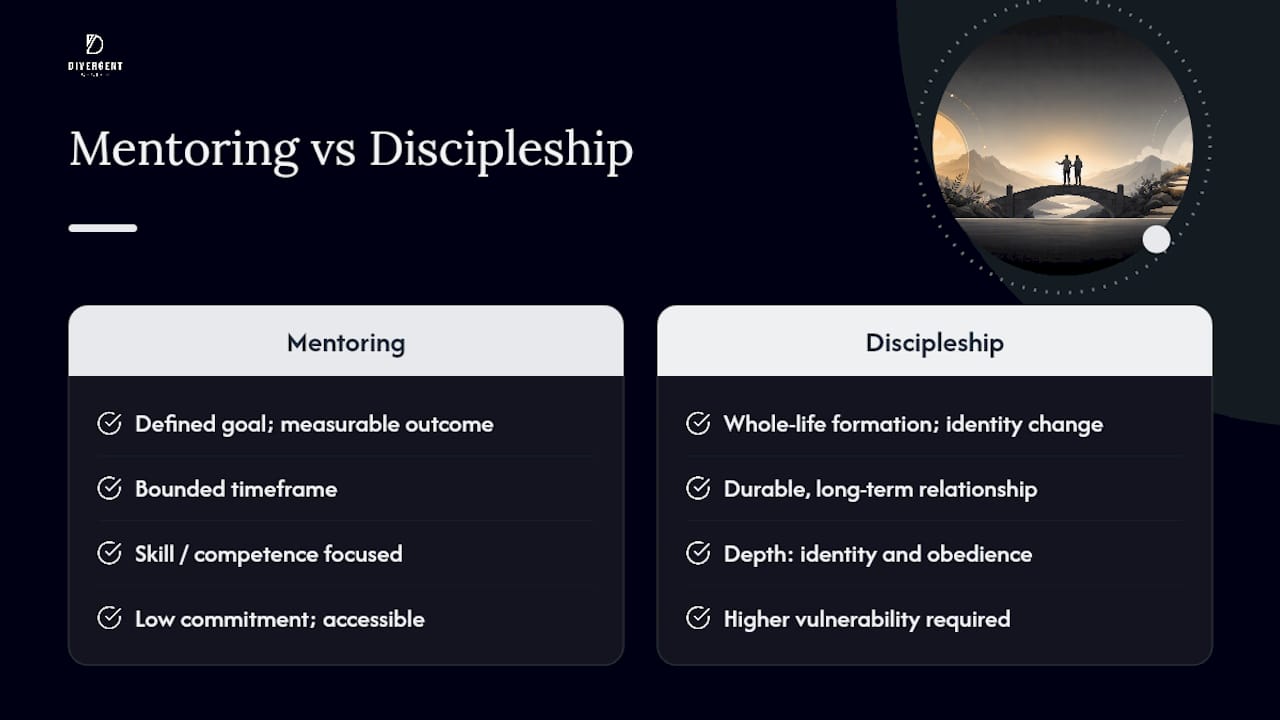
The practical answer for most churches is not choosing one over the other permanently. It is knowing which tool fits which need at a given moment, and being honest when a relationship that started as mentoring has quietly become an opportunity for something deeper.
The long term impact on spiritual growth
Mentoring’s impact tends to be visible quickly and can plateau just as fast. Someone gains a skill, applies it, and the relationship often winds down naturally once the goal is met. That is not a failure. It is simply the nature of a bounded, purpose driven relationship. But without a deeper spiritual foundation underneath it, the growth mentoring produces can remain compartmentalised, a stronger leader at work who has made no corresponding progress in prayer, humility or dependence on Christ.
Discipleship’s impact compounds differently, and more slowly. Because it is Spirit led and whole of life, the growth tends to surface in unexpected places, patience under pressure, generosity that was not there before, a marriage that looks different because both people are being shaped by Scripture rather than personal preference. The clearest long term marker, though, is multiplication. Someone who was discipled well is statistically far more likely to disciple someone else, which means the impact of a single discipling relationship can ripple through a church community for decades rather than stopping with one person’s growth.
Churches that only offer mentoring risk raising capable people who never learn to reproduce faith in others. Churches that get discipleship right end up with a self sustaining culture where growth is not dependent on a handful of gifted leaders doing all the work.
What most guides on this topic get backwards
Most advice on mentoring and discipleship treats them as a spectrum, as if discipleship is just mentoring with more Bible content stirred in. That framing undersells discipleship badly. The real distinction is not intensity, it is authority. Mentoring lets the mentee set the terms. Discipleship submits to Christ’s terms, which is a fundamentally different posture, not a deeper version of the same one.
The conventional advice also tends to obsess over structure, session templates, meeting cadences, curriculum, while glossing over the one marker that actually predicts whether discipleship worked: does the disciple go on to disciple someone else. A structure without that multiplying intent is just well organised mentoring wearing a Christian label.
If you take one thing from this, prioritise the FAT screening before you commit deeply to anyone. Faithful, available, teachable people are worth the investment discipleship demands. Chasing everyone equally spreads a discipler too thin to do either job well, and burns out the very people your church needs most.
— Josh
Take the next step with the Discipleship Hub
There are other ways to grow, workplace mentoring programs, leadership courses, self directed Bible reading. None of them are wrong, but none of them replace the shared, whole of life rhythm discipleship is built for. Some churches exist to offer that rhythm through relationships rather than a program you complete alone.
If you are ready to be discipled, or ready to start discipling someone else, the Discipleship Hub is the place to start. It lays out our pathway clearly and connects you with people already walking it. From there, joining a Life Community puts that discipleship into a lived, weekly rhythm with others in your area, rather than leaving it as a good idea you never act on. If you are new to faith altogether, our Follow Jesus pathway is the honest place to begin. And if you have questions before committing to any of it, simply get in touch and we will point you toward the right next conversation.
Sources
FAQ
What are the five C’s of mentoring?
Definitions vary across mentoring frameworks, so there is no single agreed list. Rather than force fit an acronym, focus on the practical markers this article covers, clear goals, consistent meetings, honest feedback and accountability.
What does Jesus say about mentoring?
Jesus never uses the word mentoring. He commands his followers in the Great Commission to make disciples, teaching obedience to everything he commanded, which is the scriptural basis for discipleship rather than mentoring specifically.
What are the four basics of discipleship?
Practitioner sources point to education in Scripture, growing faith, practical obedience, and multiplication, going on to disciple someone else, as the core elements that distinguish discipleship from other forms of personal growth.
What are the five pillars of mentoring?
There is no single, universally agreed list of five pillars. The consistent elements across Christian mentoring guidance are listening, wisdom from Scripture, prayer support, accountability, and knowing when to refer someone to a professional.
Is discipleship better than mentoring?
Neither is inherently better. Mentoring suits a defined skill or goal, while discipleship suits whole of life, Christ centred transformation, and many people benefit from both running at the same time.
Recommended
Comments