
The role of church in society: beyond Sunday


The role of church in society is to provide moral direction, sustain community wellbeing, and cultivate the kinds of relationships that hold a city together. This is not a claim about institutional power. It is a description of what churches, at their best, actually do in the neighbourhoods, workplaces, and universities where their people live. Research from the Angus Reid Institute and Vatican teachings alike confirm that the church’s social function extends far beyond its internal ministries. Whether you are exploring faith for the first time or reconsidering what a church community can offer, understanding this broader role changes the conversation entirely.
How does the church contribute to community service and social support?
The church’s contribution to community welfare is most visible in its practical programmes: food relief, tutoring, emergency aid, and crisis counselling. These are real and significant. But the deeper contribution is less visible and more durable. It is the formation of people who carry a posture of service into every corner of their neighbourhood, whether or not those neighbours ever attend a church service.
Research from the Angus Reid Institute shows that 86% of religiously committed people help others regularly, compared to 61% among non-believers. That gap is not explained by church programmes alone. It reflects a culture of generosity and mutual obligation that faith communities actively cultivate. When a congregation is healthy, it produces people who show up for their neighbours without being asked.
The most effective church community services operate on a partnership model rather than a direct service-provider model. A church does not need to run every food bank or tutoring programme itself. What it can do is form people with the character, relationships, and motivation to serve within existing community structures, schools, hospitals, neighbourhood associations, and local government.
Churches that embed members in existing community networks tend to create more sustainable social outcomes than those running parallel, church-branded programmes.
Volunteering motivated by faith is more consistent over time because it is grounded in conviction rather than convenience.
Presence in a neighbourhood, attending local events, knowing your neighbours by name, and showing up during crises, builds the kind of trust that no programme can manufacture.
Faith-based organisations in society often serve families who will never attend a church service, simply because a church member lives next door and is known to be trustworthy.
Pro Tip: If you are evaluating a church’s community impact, look less at its programme catalogue and more at how its members are known in the neighbourhood. Presence is the product.
What role does the church play in moral guidance and shaping social attitudes?
The church’s influence on moral values is one of the most studied and contested aspects of its social role. The Vatican frames the church as a moral beacon in history, with a specific calling to speak against what diminishes human life and to stand with the poor, the oppressed, and the victims of violence. This is not a peripheral concern. It sits at the centre of the church’s self-understanding.
How does religion shape society at the level of values and attitudes? The evidence is concrete. Research published by the American Economic Association found that faith-based government initiatives in the United States increased church attendance and produced measurable shifts in social attitudes, including changes in views on social policy, detectable four to seven years after the programmes began. This means the church’s moral influence is not merely rhetorical. It operates through community formation over time.
The church’s moral teaching is most credible when it is embodied rather than proclaimed. Consider how this works in practice:
A congregation that actively supports asylum seekers in its neighbourhood teaches solidarity more effectively than any sermon on justice.
A church that practises financial transparency and accountability models the integrity it preaches.
A faith community that includes people across economic and cultural lines demonstrates the equality it affirms theologically.
A church that listens to its city before speaking to it earns the moral authority to be heard.
“The Church’s social mission includes moral direction and hope in history’s context, requiring continual renewal.” — Holy See, General Audience, May 2026
The importance of faith in social issues is not that the church imposes a single moral framework on a plural society. It is that the church keeps certain questions alive: What do we owe one another? Who is being left behind? What does a dignified life require? These are questions that market forces and political institutions tend to defer or dissolve.
How does the church build community relationships beyond religious services?
There is a meaningful distinction between a church that serves a community and a church that is present in one. Service can be delivered from a distance. Presence requires proximity, consistency, and genuine investment in people who may never reciprocate in kind. The most enduring social impact of the church in city life comes from the second category.

The difference matters practically:
Approach | Characteristics | Likely outcome |
Service-provider model | Church runs programmes, community attends | Dependent relationships, limited trust |
Relational presence model | Members embedded in neighbourhood life | Durable trust, sustainable social change |
Partnership model | Church equips people to serve within existing structures | Multiplied impact, shared ownership |
Research on congregational engagement from the Lake Institute confirms that engaged congregations build social capital that supports democratic participation, political efficacy, and higher rates of civic involvement. Social capital is the currency of community life. It is built through repeated, low-stakes interactions: conversations at the school gate, shared meals, showing up when someone is ill. Churches, when they are functioning well, are engines of exactly this kind of capital.
The church as a social support system is not primarily about crisis intervention, though that matters. It is about the ordinary texture of belonging. A person who knows they are known, who has people who will notice their absence and ask after their wellbeing, is more resilient, more generous, and more likely to contribute to the common good. This is what church community actually produces at its best.
Pro Tip: The most powerful question a church can ask its neighbourhood is not “What do you need?” but “What do you already love about this place, and how can we be part of that?” Listening before serving changes the entire dynamic.
What are the broader societal impacts of church engagement?
Catholic social teaching defines the common good as the shared social conditions that enable people and communities to flourish fully. This includes respect for human rights, access to education and health care, meaningful employment, cultural participation, and dignified living conditions. The church’s role in society, understood through this lens, is to advocate for and embody these conditions, not merely to provide charity when they are absent.
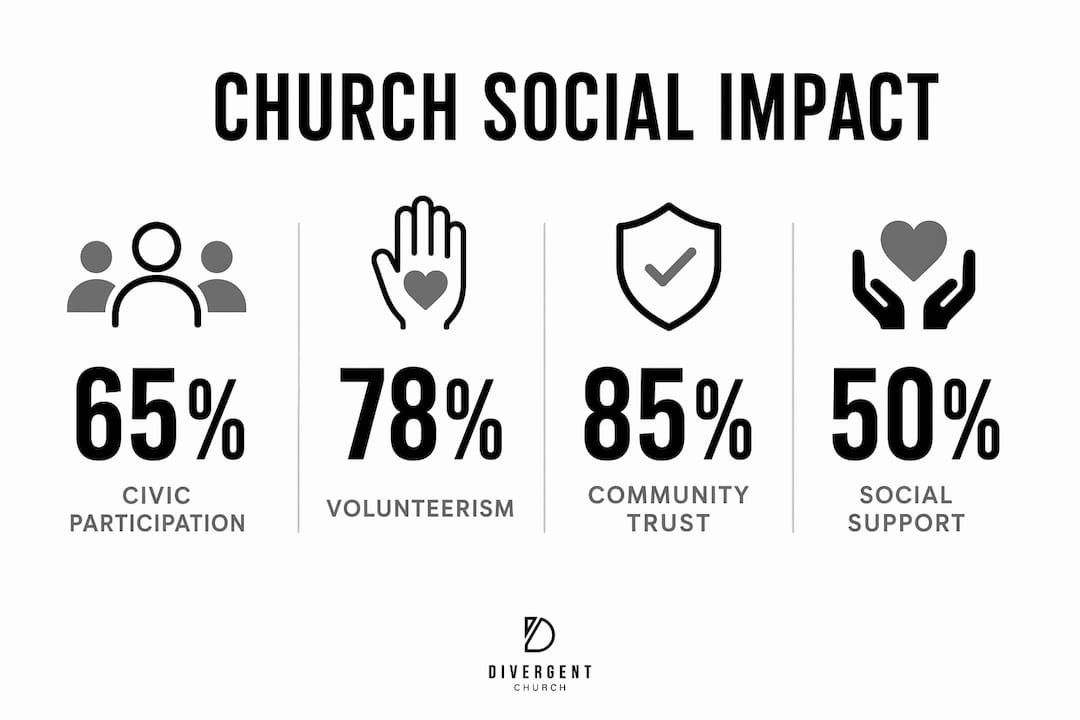
The broader societal impacts of church engagement are measurable across several dimensions:
Social dimension | Church contribution | Research basis |
Civic participation | Higher voting and helping behaviours among religiously committed | Angus Reid Institute, 2026 |
Social capital | Congregational engagement linked to democratic participation | Lake Institute, 2026 |
Moral formation | Faith-based initiatives shift social attitudes over 4 to 7 years | AEA Research, 2026 |
Community resilience | Relational presence builds trust that sustains communities through crisis | Faith in Everyday Life |
Religion and social change are not always comfortable partners. The church has, at various points in history, both advanced and resisted social progress. What the research suggests is that the direction of influence depends heavily on the theological commitments and community practices of specific congregations. A church shaped by the call to justice and solidarity will produce different social outcomes than one shaped primarily by self-preservation.
The role of churches in community development is most effective when congregations move beyond goodwill and establish routines for problem scoping, co-production with community members, and honest evaluation of outcomes. Without these practices, church networks may generate warmth but not durable change. The seeds planted in genuine relationship, however, tend to bear fruit that outlasts any single programme or initiative.
Key takeaways
The church’s most durable social contribution comes not from running programmes but from forming people who are genuinely present in their neighbourhoods, carrying the values of justice, solidarity, and care into every sphere of ordinary life.
Point | Details |
Presence over programmes | Relational embeddedness in a neighbourhood produces more sustainable impact than church-branded service delivery. |
Moral formation takes time | Faith-based community formation shifts social attitudes measurably over four to seven years, not overnight. |
Social capital is the output | Engaged congregations build civic participation, trust, and democratic involvement in their communities. |
Common good as framework | Catholic social teaching frames the church’s goal as shared flourishing, not merely individual salvation or charity. |
Listening precedes serving | Churches that listen to their city before speaking to it earn the trust and authority to make a lasting difference. |
What I’ve learned about the church’s place in the city
I have watched churches pour enormous energy into programmes that serve real needs but leave the neighbourhood largely unchanged. And I have seen small, relationally embedded communities quietly transform the social fabric of a street, a school, or a workplace, not through any formal initiative, but through the accumulated weight of faithful presence over years.
The temptation for churches is always to measure impact by activity: how many meals served, how many people attended, how many programmes running. These numbers are not meaningless. But they can obscure the more important question, which is whether the church is actually known and trusted by the people who live around it. A missional church is not one that does more. It is one that is more genuinely present.
The challenge in a city like Canberra, with its transient population, its universities, and its professional rhythms, is that presence requires patience. People move on. Relationships take time to build. The temptation is to default to events and programmes because they produce visible results quickly. But the seeds planted in genuine, unhurried relationship are the ones that actually take root.
My honest conviction is this: the church’s greatest gift to society is not its services. It is its people, formed by Scripture and shaped by love, living ordinary lives in extraordinary fidelity to their neighbours.
— Josh
Grow your faith and your community impact with Divergentchurch
If this exploration of the church’s role in society has stirred something in you, whether curiosity, conviction, or a desire to find genuine community, Divergentchurch in Canberra exists for exactly that.
Divergentchurch is not simply a Sunday gathering. It is a community shaped by Scripture, centred on Jesus, and expressed through everyday life, relationships, and mission in the city. The Discipleship Hub offers practical resources for growing in faith and deepening your social impact. Programmes like Lead Like Jesus and Life Communities are designed to form people who carry the kingdom into their neighbourhoods, workplaces, and relationships. If you are ready to explore what it means to live with purpose in Canberra, we would love to have that conversation with you.
FAQ
What is the primary role of the church in society?
The church’s primary role in society is to provide moral direction, build community relationships, and advocate for the common good. Research confirms that religiously committed people are significantly more likely to help others and participate in civic life than those with no religious affiliation.
How does the church support people who never attend services?
Churches support non-attending community members through members who are embedded in neighbourhoods, schools, and workplaces. Relational presence, rather than formal programmes, is the mechanism by which this support reaches people who would never walk through a church door.
Does religion actually change social attitudes?
Research from the American Economic Association found that faith-based initiatives produced measurable shifts in social attitudes detectable four to seven years after implementation. The church’s moral influence operates through community formation over time, not through single events or proclamations.
What is the difference between a service-provider church and a relational church?
A service-provider church runs programmes that community members attend. A relational church forms people who are genuinely present in their neighbourhood, building trust through consistency and proximity rather than through institutional competence alone.
How does the church contribute to democracy and civic life?
Engaged congregations build social capital that supports democratic participation, higher voting rates, and stronger helping behaviours, according to the Lake Institute’s research on congregational engagement. The church’s contribution to public life is most visible not in political advocacy but in the formation of citizens who show up for their communities.
Recommended
Comments