
What is church hospitality: meaning and practice


Church hospitality is defined as the intentional, Christ-centred practice of welcoming strangers and newcomers into the Christian community through genuine love, presence, and belonging. It is not about polished events or impressive programmes. It is about seeing the person in front of you and choosing to include them. At its core, church hospitality is a spiritual discipline woven into the fabric of discipleship, and understanding it well can transform how a congregation relates to the world around it.
What is the biblical meaning of church hospitality?
Biblical hospitality is grounded in the Greek word philoxenia, which translates literally as “love of strangers.” The word combines philos (love or affection) and xenos (stranger or foreigner). This is not a passive tolerance of outsiders. It is an active, courageous reaching toward those who have no prior claim on your community’s favour.
This distinction matters enormously. Much of what passes for hospitality in contemporary culture is really entertainment: curated experiences designed to impress, where the host’s reputation sits at the centre. Biblical hospitality flips that entirely, shifting attention from the host’s comfort to the stranger’s need. The Good Samaritan in Luke 10 did not pause to consider his reputation. He saw a need and moved toward it.
Paul’s letter to the Romans instructs believers to “practise hospitality” (Romans 12:13), and the word he uses is philoxenia. The writer of Hebrews adds a striking image: “Do not forget to show hospitality to strangers, for by so doing some people have shown hospitality to angels without knowing it” (Hebrews 13:2). These are not suggestions for a hospitality team. They are commands for the whole body.

There is also a harder edge to this theology worth sitting with. The root words of hospitality are related to “hostile” and “hostage,” reminding us that genuine welcome involves risk and discomfort. True Christian hospitality, sometimes called the “hospitality of the cross,” extends even to those who are difficult, unfamiliar, or socially inconvenient.
Key distinctions between biblical and secular hospitality:
Biblical hospitality centres on the stranger’s experience, not the host’s presentation
Philoxenia demands courage, not just warmth
Scriptural examples (Good Samaritan, Paul’s teachings, Hebrews 13:2) frame hospitality as sacrificial love
Entertainment-focused hospitality keeps the host’s reputation at the centre and misses the point entirely
How does church hospitality work in practice?
The practical expression of church hospitality begins the moment a visitor turns into the car park and does not end until they are genuinely woven into the life of the community. Research from Lifeway shows that 99% of churches implement some form of hospitality, with 91% offering chances to meet pastors and 80% using guest cards to assist newcomers. Welcome desks are used by 66% of churches, and information sessions by 58%. These numbers reveal that most churches are trying. They also reveal that effort alone does not guarantee genuine welcome.
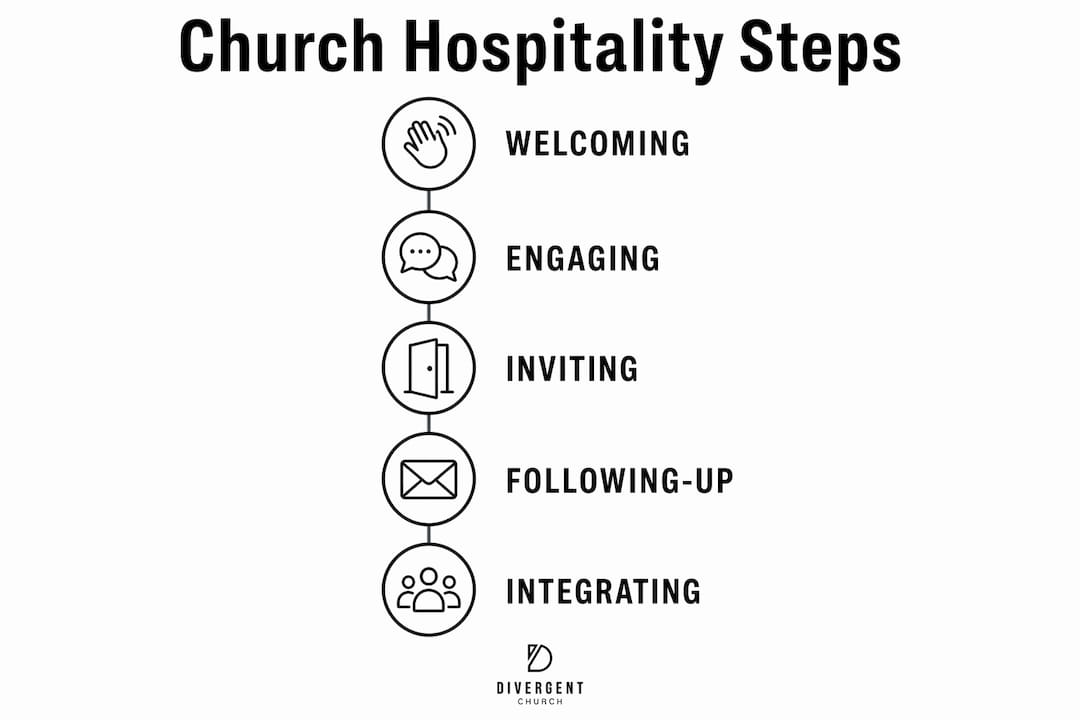
The physical environment carries more weight than most church leaders realise. Small details like clean restrooms, understandable signage, and accessible wifi reduce visitor anxiety before a single word is spoken. When a first-time guest cannot find the children’s area or deciphers a bulletin full of insider language, the message received is: this place was not built with you in mind.
Effective church welcoming practices include:
Greeters at every entry point, not just the front door
A clearly marked welcome desk staffed by warm, informed people
Guest cards that invite connection without pressure
An opportunity to meet a pastor or leader in a low-stakes setting
Follow-up within 48 hours of a first visit, whether by text, email, or a handwritten note
Clear pathways into community, such as a newcomers’ gathering or small group invitation
The congregation’s role in all of this cannot be delegated to a team. Every member who notices a new face and chooses to introduce themselves is practising hospitality. Every regular who sits beside someone they do not know is building the kind of community that church events alone cannot manufacture.
Pro Tip: After a visitor’s second attendance, a personal invitation to a small group or community meal is far more effective than another information pamphlet. Relational integration, not information transfer, is the goal.
What misconceptions hinder genuine church hospitality?
The most damaging misconception about church hospitality is that it belongs to a team. When hospitality is treated as a department, the rest of the congregation is quietly excused from the responsibility of welcome. The visitor who slips in and out of a Sunday service without a single genuine conversation has technically been “hosted” by the hospitality team. But they have not been welcomed.
“Hospitality must be a shared culture across the whole congregation rather than a burden on one team, converting hospitality from duty to spiritual practice.” — Lead Magazine
A second misconception is the confusion between hospitality and entertainment. When a church invests heavily in production quality, coffee bars, and polished first impressions while neglecting relational follow-up, it has prioritised the host’s reputation over the visitor’s experience. A newcomer can sense the difference between a community that wants to impress them and one that genuinely wants to know them.
Common pitfalls that undermine church welcoming practices:
Treating hospitality as a role rather than a shared spiritual practice
Over-investing in first impressions while neglecting follow-up and integration
Using insider language, acronyms, or assumed knowledge that excludes newcomers
Allowing fear of strangers or inward focus to limit genuine outreach
Measuring hospitality success by attendance numbers rather than relational depth
The fear of strangers is worth naming directly. Many congregations are warm toward familiar faces and unconsciously cold toward unfamiliar ones. This is not malice. It is human nature. But biblical hospitality calls the church beyond natural comfort zones, toward the kind of courageous welcome that reflects the character of Christ.
How can churches improve and cultivate a culture of hospitality?
Building a genuine culture of hospitality requires more than training a welcome team. It requires the whole congregation to understand hospitality as a spiritual practice, not a programme. Genuine hospitality increases church health by fostering authenticity, trust, and belonging, and it guards against the isolation that can fracture communities during personal or collective crises.
Pastoral leadership is the single most powerful lever available. When pastors and elders model hospitality by inviting people into their homes, sitting with newcomers over a meal, and publicly naming the value of welcome, the congregation follows. Hospitality that lives only in a programme will die when the programme ends. Hospitality that lives in the pastor’s own habits becomes part of the congregation’s DNA.
Practical strategies for building a culture of welcome:
Preach and teach on philoxenia so the whole congregation understands its biblical roots
Equip every member, not just the hospitality team, with simple welcoming skills
Create consistent follow-up pathways so no visitor falls through the cracks after their first Sunday
Integrate newcomers into Life Communities or small groups within their first month
Celebrate stories of welcome from the front, making hospitality visible and valued
Approach | What it achieves |
Team-only hospitality | Covers first impressions but misses relational depth |
Whole-congregation culture | Every member becomes a point of genuine welcome |
Pastoral modelling | Embeds hospitality into the church’s identity, not just its roster |
Consistent follow-up | Converts first-time visitors into connected community members |
Churches that extend hospitality beyond Sunday gatherings, including tangible care for vulnerable groups such as the unhoused through meals and community integration, demonstrate the full scope of what philoxenia means in practice. This is hospitality as kingdom witness, not just church management.
Pro Tip: The most effective church hospitality programme idea is a simple newcomers’ gathering hosted in a home rather than a church building. The informal setting signals that belonging happens in everyday life, not just on Sundays.
Key takeaways
Church hospitality is the whole congregation’s calling, rooted in philoxenia, expressed through genuine relational welcome, and sustained by pastoral modelling and consistent follow-up.
Point | Details |
Biblical foundation | Hospitality is philoxenia, love of strangers, not entertainment or first impressions. |
Whole-congregation practice | Every member carries the responsibility of welcome, not just a designated team. |
Follow-up is non-negotiable | Relational integration after the first visit determines whether newcomers stay connected. |
Pastoral modelling matters | Leaders who practise hospitality personally embed it into the congregation’s culture. |
Culture over programme | Hospitality sustained by shared values outlasts any event or team structure. |
Hospitality is the shape of love made visible
I have sat in churches where the welcome team was excellent and the community was cold. I have also sat in churches with no formal hospitality programme at all, where a stranger could not make it to the door without being genuinely known. The difference was never the budget or the signage. It was whether the people believed that the stranger in their midst was worth interrupting their Sunday routine for.
What strikes me most about philoxenia is that it is not a gift some people have and others do not. It is a practice. It is a decision made before you walk through the door: I will notice the person who looks lost. I will sit beside someone I do not know. I will follow up. The importance of church hospitality is not primarily about church growth metrics, though genuine welcome does grow churches. It is about whether the body of Christ actually looks like Christ to the people watching from the edges.
At Divergentchurch, we talk about being a community shaped by Scripture and expressed through everyday life. Hospitality is where that becomes concrete. It is the seed planted in a single conversation, the door held open, the text sent on a Tuesday. These are not small things. They are the building blocks of a community where people genuinely belong.
If you are exploring what it means to invite others into community, the practice of hospitality is where that journey begins.
— Josh
Grow in hospitality with Divergentchurch
Divergentchurch exists to form disciples of Jesus in the rhythms of Canberra life, and hospitality is woven into everything we do. Whether you are new to faith or looking to go deeper, our Discipleship Hub holds resources designed to help you grow in community, welcome, and Christlike living. Our Life Communities are small groups where hospitality is not a programme but a way of life, practised around tables and in everyday relationships. If you want to understand what it means to follow Jesus in a community that genuinely welcomes the stranger, we would love for you to take the next step with us.
FAQ
What does church hospitality mean?
Church hospitality means the intentional, Christ-centred practice of welcoming strangers and newcomers into Christian community through genuine love and presence. It is rooted in the biblical concept of philoxenia, meaning “love of strangers,” and applies to the whole congregation, not just a welcome team.
Why is church hospitality important?
Church hospitality is important because it is central to discipleship and reflects the character of Christ toward those on the outside. Research shows that genuine hospitality increases church health by building authenticity, trust, and belonging across the whole community.
What are some church hospitality best practices?
The most effective church hospitality best practices include training every member (not just a team) in welcoming skills, creating clear follow-up pathways within 48 hours of a first visit, and integrating newcomers into small groups within their first month. Pastoral modelling of hospitality in everyday life is the most powerful single factor.
How is biblical hospitality different from entertainment?
Biblical hospitality centres on the stranger’s experience and needs, while entertainment keeps the host’s reputation at the centre. The distinction is that philoxenia demands sacrificial, courageous welcome rather than a polished presentation designed to impress.
What are practical church hospitality programme ideas?
Practical church hospitality programme ideas include hosting newcomers’ gatherings in homes rather than church buildings, equipping all members with simple welcoming skills, and creating small group pathways for relational integration. Tangible care for vulnerable groups such as providing meals or community support also demonstrates the full biblical scope of welcome.
Recommended
Comments