
What is church multiplication: a guide for leaders


Church multiplication is defined as the intentional process of reproducing disciples, leaders, and new churches to expand God’s presence across communities and generations. Where simple church growth adds people to existing gatherings, multiplication plants seeds that grow into entirely new communities of faith. Alliance South defines multiplication DNA as expanding God’s presence through reproduction and deployment using diverse methods. This is not a modern management technique. It is the heartbeat of the Great Commission, and understanding church multiplication is the first step toward living it out faithfully.
What is church multiplication and why does it matter?
Church multiplication is the process by which a church reproduces itself through the consistent making, training, and sending of disciples who go on to form new communities of faith. The Asbury Center for Church Multiplication offers a definition worth anchoring to: a healthy, multiplying church is a sustainable community that regularly worships, disciples, and fulfils the Great Commission by making disciples who make disciples. That definition is significant because it ties health to reproduction. A church that is not multiplying is, in some sense, not yet fully expressing what it was made to be.
Why does this matter so deeply? Because Jesus did not commission us to fill buildings. He commissioned us to make disciples of all nations (Matthew 28:19). Multiplication is not merely a church growth strategy. Multiplication is integral to the church’s DNA, rooted in Jesus’ mandate to make disciples who reproduce disciple-makers. When a church grasps this, everything shifts. The goal is no longer a bigger Sunday gathering. The goal is a movement.

At Divergentchurch in Canberra, this conviction shapes how we think about community, mission, and leadership. We are not simply trying to grow a congregation. We are trying to form disciples who form disciples, in the rhythms of the city, in workplaces and universities and neighbourhoods.
What are the core components of church multiplication?
Discipleship.org outlines four multiplication types that form a generational framework: personal multiplication, group multiplication, church multiplication, and network multiplication. Each stage builds on the one before it, and each is necessary for the whole movement to sustain itself.
Here is how those stages work in practice:
Personal multiplication is where it all begins. One disciple intentionally invests in another, teaching them to obey Scripture, to pray, and to share their faith. This is the seed stage. Without it, nothing else grows.
Group multiplication happens when a small group or community group grows in maturity and then reproduces itself by sending out members to form a new group. The group does not simply get bigger. It gets generative.
Church multiplication occurs when a local church plants or sends out a team to establish a new congregation. This is the most visible expression of multiplication, and it requires intentional leadership development and deployment.
Network multiplication is the collaboration between multiple churches and leaders to plant even more churches. Networks create the relational infrastructure that allows multiplication to scale beyond what any single church could achieve alone.
Each stage requires leaders who are not just gifted but reproducible. The question is not only “Can this person lead?” but “Can this person develop other leaders?” That distinction is the difference between a church that grows and a church that multiplies.
Pro Tip: Start by identifying one or two people in your congregation who are already discipling others informally. These are your multiplication catalysts. Invest in them first, and let the movement grow from there.
How does church multiplication differ from church growth?
Many church leaders use the words “growth” and “multiplication” interchangeably. They are not the same thing, and the distinction carries real consequences for how you lead.
Church growth, in its most common form, is addition. Attendance increases. The budget grows. New programmes are added. These are not bad things. But addition depends entirely on the capacity of the existing church. When the senior pastor is the primary attractor, growth stalls the moment that person is unavailable or moves on.
Multiplication, by contrast, is exponential. It does not depend on one leader or one location. It depends on a culture of disciple-making that is woven into the fabric of the community. Multiplication requires evaluating what church expression will best fit a particular community and growth stage, rather than defaulting to a full new launch every time.
Here is a comparison of the most common approaches:
Approach | Core mechanism | Scalability | Key risk |
Attendance growth | Marketing and programming | Limited by facility and staff | Leader dependency |
Multisite campuses | Video or live teaching at new venues | Moderate, tied to central brand | Centralised culture |
Church planting | Sending a team to start a new church | High, if leaders are developed | Resource strain |
Micro-churches | Small, reproducible communities | Very high | Lack of theological depth |
Network multiplication | Relational collaboration between churches | Exponential | Requires trust and alignment |
The most effective church growth strategies are those that build multiplication into the method itself. LCBC Church in Pennsylvania is a well-known example of a congregation that deliberately chose flexible multiplication models over a single-site expansion approach, recognising that different communities needed different expressions of church.
A few questions worth asking your leadership team:
Are we producing disciples who produce disciples, or are we producing consumers who attend services?
Do our structures reward addition or reward reproduction?
If our senior leader left tomorrow, would multiplication continue?
These are not comfortable questions. They are the right ones.
What practical steps support effective church multiplication?
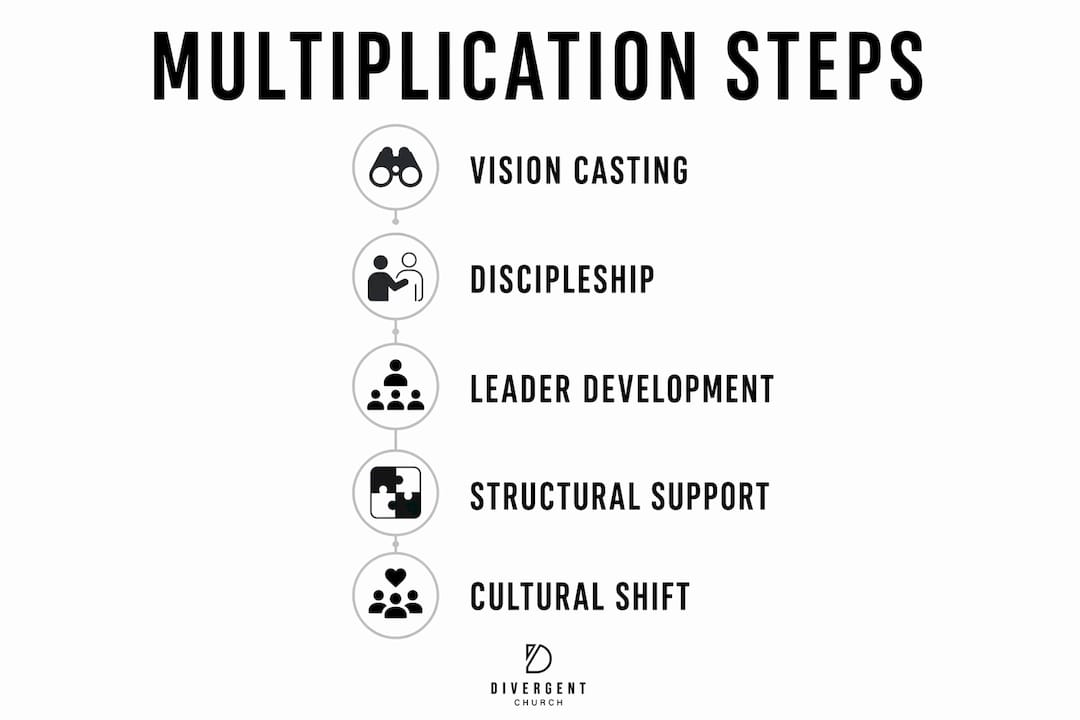
Multiplication does not happen by accident. It requires deliberate cultural shifts and structural investments. The following steps are drawn from movement frameworks and practitioner experience.
Cast a vision rooted in Scripture. Before any structure is built, leaders must carry a genuine burden for multiplication. This is not a strategic plan. It is a prophetic conviction that the church exists to reproduce itself for the sake of the kingdom. Share that vision repeatedly, from the pulpit, in small groups, and in one-on-one conversations.
Build a discipleship pipeline. Sustainable multiplication depends on replicable disciple-making leadership models and systemic training and deployment processes, not just replicating gathering formats. This means creating clear pathways: from new believer, to growing disciple, to community group leader, to church planter. Every step should be intentional and supported.
Develop leaders before you need them. The most common reason multiplication stalls is a shortage of qualified leaders. The solution is not to wait until a planting opportunity arises. The solution is to be developing leaders constantly, so that when the moment comes, you have people ready to be sent.
Balance standardisation with local flexibility. Some things must be reproducible: core theology, discipleship rhythms, accountability structures. Other things must be contextual: worship style, meeting format, community focus. Holding that tension well is one of the marks of a mature multiplication culture.
Handle resistance with grace. Cultural change in a church is slow and sometimes painful. Some members will feel that multiplication means abandonment. Pastoral care and honest communication are not optional extras in this process. They are the process.
Pro Tip: Multiplication efforts without clear leadership processes and coaching lead to burnout and stalled growth. Build a structured pipeline to identify, train, send, and coach disciple-makers before you launch anything new.
What forms does church multiplication take in practice?
Multiplication is not a single model. It is a posture that expresses itself differently depending on context, community, and calling. Understanding the range of expressions helps leaders choose wisely rather than defaulting to the most familiar option.
Traditional church planting involves sending a core team from an existing church to establish a new congregation in a new location. This is the most resource-intensive model but often produces the most theologically grounded communities.
Multisite campuses allow a church to extend its teaching and culture into new venues, often using video or live teaching. This model suits churches with a strong central identity and the infrastructure to support multiple sites.
Micro-churches and house churches are small, reproducible communities that meet in homes, cafes, or workplaces. They are low-cost and highly contextual, making them well-suited to university campuses, transient populations, and post-Christian neighbourhoods.
Community groups that multiply are perhaps the most overlooked form of multiplication. When a small group matures and sends out members to form a new group, it is practising multiplication at the most grassroots level. This is where the culture of reproduction is formed.
Network multiplication is the relational collaboration between churches to plant more churches. Church networks function as relational structures where churches collaborate in mission, helping overcome the limitations of individual congregations.
The following table shows how these expressions differ in their primary focus:
Expression | Primary focus | Best suited for |
Traditional church plant | New congregation | Established sending churches |
Multisite campus | Extended reach | Strong central brand churches |
Micro-church | Contextual community | Transient or post-Christian areas |
Multiplying community group | Grassroots reproduction | All church sizes |
Network collaboration | Shared mission | Multiple churches in a region |
For a church like Divergentchurch, operating in Canberra’s transient, university-influenced environment, the most fruitful expressions are often the most relational and reproducible ones. Exploring church partnerships for mission and investing in what a healthy church community looks like are practical starting points for any leader thinking about multiplication.
Key takeaways
Church multiplication is the only church growth strategy that is inherently self-sustaining, because it reproduces the disciple-making process itself, not just the gathering.
Point | Details |
Multiplication vs. addition | Multiplication reproduces disciple-makers; addition only grows attendance at existing gatherings. |
Four stages of multiplication | Personal, group, church, and network multiplication each build on the previous stage. |
Leadership pipeline is non-negotiable | Structured coaching and training prevent burnout and sustain momentum across generations. |
Flexible models fit context | Micro-churches, networks, and community groups multiply effectively in contexts where traditional planting cannot. |
Culture precedes structure | Multiplication must be embedded in the church’s DNA before any formal strategy will take root. |
Why I believe multiplication is the most urgent conversation in the church today
I have sat with enough church leaders to know that most of them want to see their churches grow. What fewer of them have wrestled with is whether their church is designed to reproduce. Those are very different ambitions, and the gap between them is where most multiplication efforts quietly die.
The uncomfortable truth I have come to is this: a church can be full, healthy, and deeply loved by its community, and still be failing at multiplication. Not because the leaders are lazy or the people are uncommitted, but because the culture was never built for reproduction. The Sunday gathering was the product, not the disciple.
What I have found actually works is starting small and starting with people, not programmes. Identify the two or three people in your congregation who are already asking discipleship questions and investing in others. Pour into them. Give them language, structure, and permission. Let them lead a community group. Then watch what happens when that group multiplies.
The other thing I would say to any leader reading this: do not wait until you feel ready to multiply. The leaders who plant churches and send teams are rarely the ones who felt fully prepared. They are the ones who trusted that God’s design for the church is reproduction, and stepped into it anyway. Multiplication is not a programme you launch. It is a conviction you carry, and a culture you build, one disciple at a time.
— Josh
How Divergentchurch supports multiplication and discipleship
Divergentchurch exists to form disciples of Jesus and cultivate authentic, missional community in Canberra. If you are a church leader or individual seeking to understand how multiplication takes root in real communities, the resources at Divergentchurch are built for exactly that. The Discipleship Hub offers training and tools grounded in Scripture, designed to help you build the kind of disciple-making culture that multiplication requires. For leaders ready to go deeper, the Lead Like Jesus programme provides a structured pathway for developing the leadership capacity your church needs to send and sustain new communities of faith. Multiplication begins with a disciple. Start there.
FAQ
What is the simplest definition of church multiplication?
Church multiplication is the process of reproducing disciples, leaders, and churches so that new communities of faith are continually formed. It is distinct from church growth because it focuses on reproduction rather than attendance increase.
How does church multiplication relate to the Great Commission?
The Great Commission (Matthew 28:19) calls followers of Jesus to make disciples of all nations. Church multiplication is the structural expression of that command, creating generational chains of disciple-making that extend the gospel beyond any single congregation.
What is the difference between church planting and church multiplication?
Church planting is one expression of multiplication, specifically the act of establishing a new congregation. Church multiplication is the broader culture and process that includes personal discipleship, group reproduction, church planting, and network collaboration.
How long does it take to build a multiplication culture?
Most movement practitioners suggest that embedding a genuine multiplication culture takes three to five years of consistent vision-casting, leadership development, and structural investment. There are no shortcuts, but the compounding effects over time are significant.
Can a small church practise church multiplication?
A small church can and should practise multiplication, beginning at the personal and group level. Micro-churches and multiplying community groups are models specifically suited to smaller congregations, and missional church principles apply regardless of size.
Recommended
Comments