
Benefits of church membership: a 2026 guide


Church membership is a covenantal commitment to a local body of believers that provides belonging, accountability, and spiritual growth. Research now confirms what Scripture has always taught: committed participation in a faith community produces measurable benefits across mental health, physical wellbeing, and personal transformation. The benefits of church membership extend well beyond attending a Sunday service. They reach into everyday life, shaping how you face hardship, build relationships, and grow as a disciple of Jesus. Whether you are exploring faith for the first time or looking to move from casual attendance to genuine belonging, understanding what membership offers changes everything.
What are the real benefits of church membership?
Church membership is defined as a formal, mutual commitment between an individual and a local congregation. It is distinct from simply attending services or identifying loosely with a faith tradition. Membership means you are known, you are accountable, and you are responsible to others in return.
The core advantages of church membership fall into three categories: spiritual formation, relational support, and personal wellbeing. Each of these is grounded in both Scripture and contemporary research. Understanding all three helps you see why church membership matters far more than most people realise before they commit.

The church is not a service you consume. It is a body you belong to. That distinction shapes everything about what membership can do for you.
What does church membership mean biblically and historically?
The biblical foundations of church membership are older and more specific than most people assume. Acts 2:41 records that three thousand people were added to the early church on a single day. That word “added” implies a defined group with identifiable boundaries. Paul’s instruction in 1 Corinthians 5:12–13 assumes the church knows who is inside and who is outside its community. Early churches counted their members and leaders knew exactly who they were shepherding.
This is not bureaucracy. It is pastoral care made possible by clarity. When leaders know who belongs to their community, they can pray specifically, teach purposefully, and respond quickly when someone is struggling.
Modern membership formalises these ancient practices. It answers the question every church leader must be able to answer: “Who am I responsible for?” Consider what membership actually involves:
Commitment to attend and participate regularly, not just occasionally
Accountability to church leadership for spiritual growth and conduct
Responsibility to care for other members through prayer, encouragement, and practical support
Participation in church governance, including voting on budgets, pastoral appointments, and major decisions
Access to pastoral care, including counselling, crisis support, and spiritual direction
Membership separates those who are passing through from those who are planting roots. That distinction matters enormously when life gets hard.
How does church membership support mental and physical health?
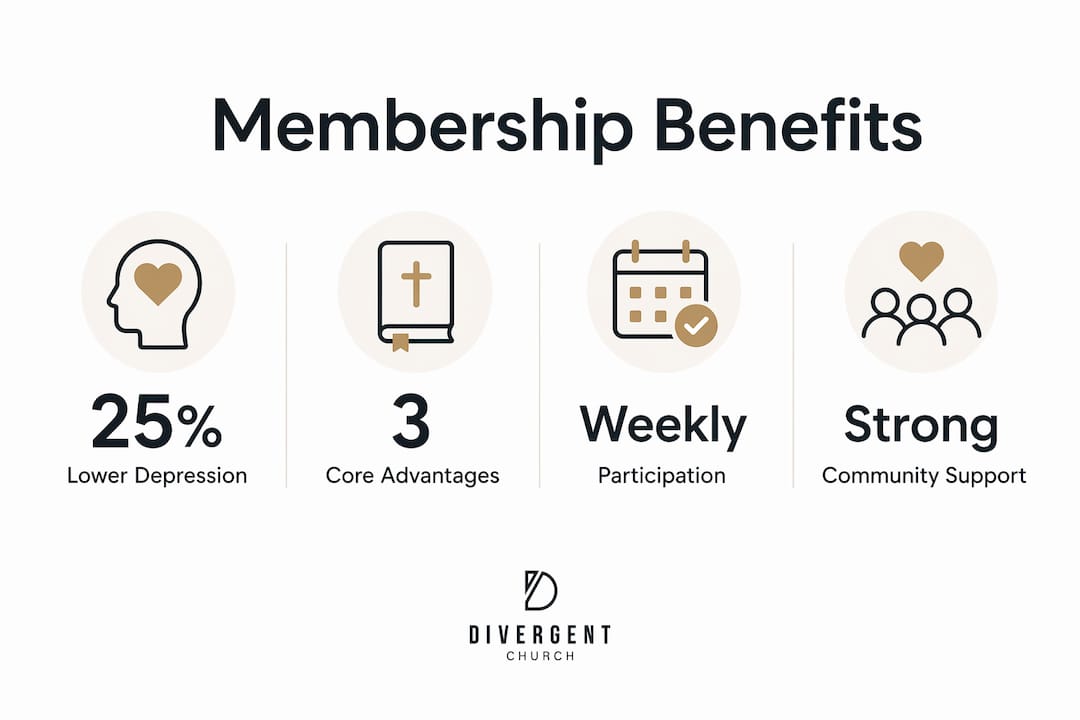
The research on religion and health is now substantial enough to move beyond anecdote. Positive associations between religious participation and mental health outnumber negative ones by about 10 to 1. That ratio comes from a decades-long analysis of the field, and it represents one of the strongest signals in the social science of religion.
A 16-year longitudinal study of 49,000 nurses found that weekly attendance linked to a 25% lower probability of depression. That is a clinically meaningful reduction, not a marginal one. Religious involvement also shows positive benefits across 15 physical health measures with a 7 to 1 positive-to-negative ratio, including associations with longevity and reduced disease risk.
The critical finding is this: committed participation is what drives the threshold effect. Casual or irregular attendance produces far weaker results. The benefits accumulate with consistent, engaged involvement. Membership creates the structure that makes consistency possible.
One important nuance: the health of the local congregation matters. Sociologists note that unhealthy or abusive church environments can harm rather than help. Choosing a community with sound leadership and genuine care is not optional. It is the foundation on which all other benefits rest.
What practical benefits come from being a committed church member?
Committed church membership delivers four practical benefits that casual attendance simply cannot replicate.
Pastoral care and spiritual guidance. Membership creates a defined group that church leaders are responsible to teach, pray for, and counsel. When you are a member, your pastor knows your name, your struggles, and your history. That informed, focused care is qualitatively different from generic encouragement offered to a crowd.
Crisis support before you need it. The most important insight from recent research is that you should join a church before an emergency. Church structures provide pastoral and communal response to burnout, marriage breakdown, health emergencies, and grief. If you wait until crisis hits to find community, the relationships are not yet deep enough to carry you.
Accountability for personal transformation. Membership keeps an open door of change. Regular accountability through known relationships produces resilience and growth that self-directed faith rarely achieves. You are not just attending; you are being shaped.
Participation in church mission and governance. Formal membership determines voting rights for budgets, pastoral appointments, and bylaw changes. Members are not passengers. They are co-owners of the mission.
Pro Tip: Think of church membership as an advance directive for your spiritual health. You decide in a season of strength who will care for you when you are weak. That decision made early is worth far more than one made in crisis.
The power of church community is not abstract. It shows up in the specific, practical ways people carry each other through real life.
How does church membership deepen fellowship and spiritual growth?
Fellowship in the New Testament is not a social activity. The Greek word koinonia describes a shared participation in something held in common. In the church, that shared thing is Christ himself. Fellowship is a means of grace, not merely a social benefit. Through prayer, shared life, correction, and encouragement, members support each other’s growth in ways that no individual spiritual practice can replicate.
“Bearing one another’s burdens, encouraging the fainthearted, forgiving one another, and praying for each other are not optional extras for the spiritually advanced. They are the ordinary means by which disciples grow. Membership is the structure that makes these ‘one another’ commands possible in practice.”
Scripture uses three metaphors to describe the church’s interdependence: a body, a household, and a flock. Each image communicates the same truth. Individual members are not self-sufficient. They need each other to function, to belong, and to be protected.
The one another commands in Scripture make this concrete. Believers are called to:
Bear one another’s burdens (Galatians 6:2)
Encourage one another daily (Hebrews 3:13)
Confess sins to one another (James 5:16)
Pray for one another (James 5:16)
Forgive one another (Colossians 3:13)
None of these commands can be fulfilled by attending a service anonymously. They require known relationships, sustained over time, within a committed community. Membership is the structure that makes them possible.
If you are wondering whether church involvement beyond Sunday is worth the investment, the answer is found here. Spiritual maturity is not a solo project. It is a community outcome.
Finding the right community is also part of the process. Resources like connecting with a spiritual community can help you identify what to look for before you commit.
Key takeaways
Church membership is the single most effective structure for accessing the spiritual, relational, and health benefits that committed religious participation produces.
Point | Details |
Membership is covenantal, not casual | Formal commitment enables pastoral care, accountability, and genuine belonging. |
Research backs the benefits | Religious involvement shows a 10 to 1 positive-to-negative ratio on mental health outcomes. |
Crisis support requires prior commitment | Join a community before an emergency so relationships are deep enough to carry you. |
Fellowship is a means of grace | The “one another” commands require known, sustained relationships that only membership provides. |
Congregation health matters | Choose a community with sound leadership; the quality of the local church shapes the benefits you receive. |
Why I think membership is the most underrated decision in a person’s faith life
People often resist church membership because it feels like paperwork. A form to sign, a class to attend, a box to tick. After years of pastoral ministry, I am convinced that resistance misses the point entirely.
Membership is not administrative. It is protective. When someone I know is in crisis, I can act. I know their name, their family, their history. I can call, visit, pray, and mobilise others to help. Without membership, I am guessing who belongs to my care. With it, I know.
The most moving moments I have witnessed in ministry have come from that clarity. A family facing a sudden health crisis, surrounded within hours by people who knew them and loved them. A young adult in Canberra, far from home, held by a community that had already invested in knowing them. These things do not happen by accident. They happen because someone made a commitment before the emergency arrived.
Membership is also the structure through which people change. Not the only structure, but a vital one. Accountability without relationship is just surveillance. Membership creates the relationship that makes accountability feel like love rather than control.
If you are sitting in the back row, watching but not belonging, I want to invite you to consider what you are missing. Not the services. The people. The commitment. The grace that flows through known, trusted, mutual relationships. That is what church is meant to be.
— Josh
Divergentchurch: a place to belong in Canberra
Divergentchurch exists within the rhythms of Canberra’s universities, workplaces, and neighbourhoods. We are not simply a Sunday gathering. We are a community shaped by Scripture, centred on Jesus, and expressed through everyday life and relationships.
The Discipleship Hub is the starting point for anyone ready to move from attendance to committed membership. It brings together practical classes, spiritual formation pathways, and the relational structures that make growth real. Our Life Communities are small groups where the “one another” commands of Scripture become lived experience, not theory. If you are ready to plant roots and belong to something that will carry you through every season, your next steps start here.
FAQ
What is church membership exactly?
Church membership is a formal, mutual commitment between an individual and a local congregation. It creates defined accountability, access to pastoral care, and responsibility to care for fellow members.
Why join a church rather than just attending?
Attendance is passive; membership is participatory. Research shows that committed participation produces the strongest mental and physical health benefits, and crisis support requires relationships built before the emergency arrives.
What are the spiritual benefits of church fellowship?
Fellowship as koinonia is a means of grace through which believers bear burdens, encourage, correct, and pray for one another. These practices, enabled by membership, produce spiritual maturity that individual faith practice alone cannot achieve.
Does church membership improve mental health?
Studies show a 10 to 1 ratio of positive to negative mental health outcomes associated with religious participation. Weekly attendance specifically links to a 25% lower probability of depression in long-term research.
How do I know if a church is worth joining?
Look for sound, accountable leadership and a culture of genuine mutual care. Sociologists note that congregation health critically affects the benefits an individual receives, so the quality of the local community matters as much as the decision to join.
Recommended
Comments