
Why church diversity matters for vibrant faith


Church diversity is defined as the intentional inclusion of people from different ethnicities, cultures, languages, and backgrounds within a single congregation, and it is one of the most theologically grounded and practically urgent callings in Christian life today. The biblical vision is clear: Revelation 7:9 portrays a great multitude from every nation and language standing before the throne of God. That image is not a distant aspiration. It is the destination the Church is called to embody now, in its gatherings, its leadership, and its everyday relationships. At Divergentchurch in Canberra, this conviction shapes how we think about community, mission, and what it means to follow Jesus together.
Why church diversity matters for community and decisions
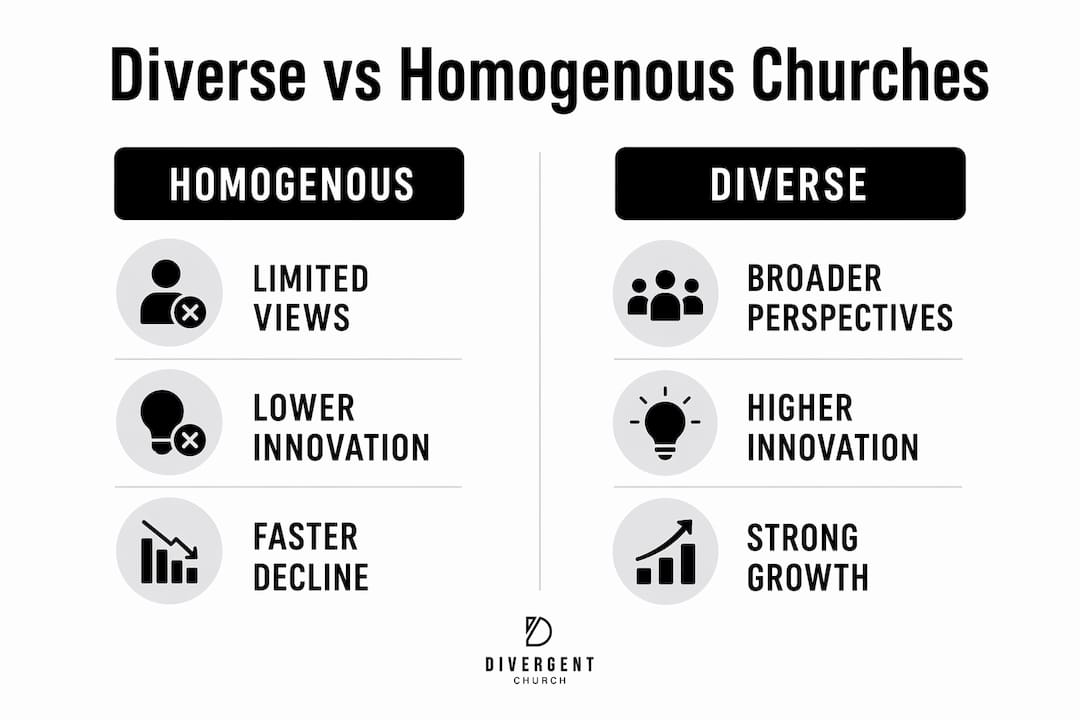
Diverse churches make measurably better decisions. Research shows that high-diversity teams improve decision-making by 20% and have a 70% higher chance of capturing new markets. Applied to a church context, this means congregations that reflect their local communities are far more likely to reach those communities effectively through evangelism and outreach.

The same research links diversity to a 19% higher innovation rate in organisations that embrace it. For churches, innovation is not about trendy programmes. It is about finding fresh, culturally resonant ways to share the gospel with people who have been overlooked by homogenous congregations. A church that looks like only one slice of its city will struggle to speak meaningfully to the rest of it.
The data on decline is equally sobering. Misalignment with local demographics since the 1970s correlates directly with church decline. This means congregations that have failed to reflect the cultural and ethnic reality of their neighbourhoods have not simply missed a social opportunity. They have weakened their own witness and growth.
Factor | Homogenous church | Diverse church |
Decision-making quality | Limited by shared assumptions | 20% improvement from varied perspectives |
Outreach effectiveness | Reaches familiar demographics only | 70% higher chance of expanding reach |
Innovation in ministry | Constrained by cultural uniformity | Generates more creative gospel expressions |
Community credibility | Perceived as culturally narrow | Reflects and engages the broader community |
Pro Tip: Before launching a diversity programme, audit your congregation’s demographics against your suburb or city. The gap between the two is your mission field.
What biblical foundations support church diversity?
The importance of church diversity is not a concession to social trends. It is a kingdom imperative rooted in Scripture. The Apostle Paul’s teaching in Galatians 3:28 declares that in Christ there is neither Jew nor Greek, slave nor free. This is not a metaphor for spiritual equality alone. It is a description of the new humanity the Church is called to display.
“After this I looked, and there before me was a great multitude that no one could count, from every nation, tribe, people and language, standing before the throne and before the Lamb.” — Revelation 7:9 (NIV)
This vision is the telos, the end goal, of all Christian community. The ACSD makes the point clearly: diversity initiatives must be anchored in Scripture to endure cultural change rather than being driven by fleeting social trends. A church that pursues diversity because it is culturally fashionable will abandon it when the culture shifts. A church that pursues diversity because it is written into the DNA of the gospel will hold fast.
Paul’s letter to the Ephesians describes the Church as a new creation where the dividing wall of hostility has been torn down (Ephesians 2:14). That wall was ethnic, cultural, and religious. The Church’s calling is to live as though it has already been demolished, not to rebuild it through comfortable homogeneity. This is why church unity and diversity are not competing values. They are the same vision expressed from different angles.
Pro Tip: When preaching on diversity, ground every message in a specific biblical text rather than general principles. Congregations trust Scripture far more than sociological arguments.
How does church diversity enrich worship and faith discussions?
Diverse congregations produce richer worship because they bring a wider range of cultural expressions to the encounter with God. A congregation that includes people from South Sudan, the Philippines, East Asia, and First Nations Australia does not simply add colour to a Sunday gathering. It multiplies the ways in which God’s character is praised, named, and experienced.
The benefits of diversity in churches extend well beyond music and liturgy. Consider what changes when a faith discussion includes voices from different cultural backgrounds:
Theological blind spots are exposed. Every culture reads Scripture through its own lens, and a monocultural church will miss what other lenses reveal.
Pastoral care deepens. People from different backgrounds bring different understandings of grief, community, family, and healing.
Evangelism becomes more credible. A visibly reconciled community is a more compelling witness to the gospel than any sermon series.
Discipleship grows more honest. Cross-cultural relationships surface assumptions and habits that same-culture friendships rarely challenge.
The key distinction here is accommodation over assimilation. True inclusion requires the majority culture to adjust its practices rather than expecting minorities to conform. This is uncomfortable work. It means rethinking music choices, preaching styles, hospitality practices, and even meeting times. But it is the only path to genuine belonging rather than polite tolerance.
Tokenism is the counterfeit version of this. Meaningful diversity flourishes through intentional, relational inclusivity in everyday church life, not through placing one person from a minority background on a stage. The difference is felt immediately by those on the receiving end.
Pro Tip: Ask people from minority backgrounds in your congregation what they have had to give up to belong. Their answers will tell you more about your church culture than any survey.
What practical steps build and sustain a diverse church?
Building genuine diversity in a congregation requires a sequence that most churches skip. The temptation is to launch a programme, hire a staff member, or redesign a service. But effective diversity work begins with listening, cultural intelligence, and repentance rather than immediate structural change. Leaders must first understand what cultural assumptions are embedded in their current practices before they can create genuine space for others.
Here is a practical sequence for churches serious about this work:
Listen before you lead. Conduct honest conversations with people from different backgrounds, both inside and outside your congregation. Ask what barriers exist to belonging.
Develop cultural intelligence. Leaders should engage resources like the Cultural Intelligence Centre’s CQ framework or books such as Ministering Cross-Culturally by Sherwood Lingenfelter to build genuine understanding.
Repent where necessary. Some churches carry histories of exclusion, whether through explicit racism or through cultural practices that have made certain people feel unwelcome. Naming this honestly is not weakness. It is the gospel at work.
Share leadership across backgrounds. Leadership shared across diverse backgrounds signals to the whole congregation that diversity is structural, not decorative. A leadership team that does not reflect the community it serves will struggle to lead that community well.
Build diversity in small spaces first. Research confirms that trust forms across cultural lines most effectively in small, relational settings rather than through diverse leadership representation alone. Intentionally mixed small groups are where real reconciliation happens.
Move from assimilation to accommodation. Review your worship, hospitality, and community rhythms. Ask which practices assume a single cultural norm and adjust them to create genuine space.
Multiethnic churches that embody reconciliation visibly reinforce gospel credibility in increasingly diverse societies. This is not a secondary concern for progressive congregations. It is a faithful witness that every church in a multicultural city like Canberra is called to pursue.
Key takeaways
Church diversity matters because it is simultaneously a biblical mandate, a missional strategy, and a prophetic witness to the reconciling power of the gospel.
Point | Details |
Biblical foundation | Revelation 7:9 and Ephesians 2:14 ground diversity in Scripture, not social trends. |
Decision-making and outreach | Diverse teams improve decisions by 20% and expand outreach reach by 70%. |
Accommodation over assimilation | Majority cultures must adjust practices to create genuine belonging for all. |
Small groups as the engine | Trust across cultural lines forms most effectively in relational, small-group settings. |
Listening before leading | Cultural intelligence and repentance must precede any structural diversity changes. |
Why I believe diversity is the Church’s most urgent witness
I have watched congregations pursue diversity as a project and fail. The ones that succeed treat it as a posture, a way of seeing people that flows from the gospel rather than from strategy. When a church genuinely reflects the neighbourhood around it, something shifts in the room. Worship feels less like a performance and more like a foretaste of something eternal.
The hardest part is not finding diverse people. Canberra is one of the most internationally diverse cities in Australia. The hardest part is creating the conditions where people from different backgrounds genuinely want to stay. That requires the majority culture to give things up, comfort, familiarity, control over the aesthetic. Most churches are not willing to do that, and so they remain homogenous by default.
Gospel-centred discipleship is the only framework I have found that makes this sustainable. When people are genuinely formed by the life of Jesus, they develop the humility and curiosity that cross-cultural relationships require. Diversity is not the goal in itself. It is the fruit of a community that has taken the gospel seriously enough to let it reshape everything.
— Josh
Discover diverse discipleship at Divergentchurch
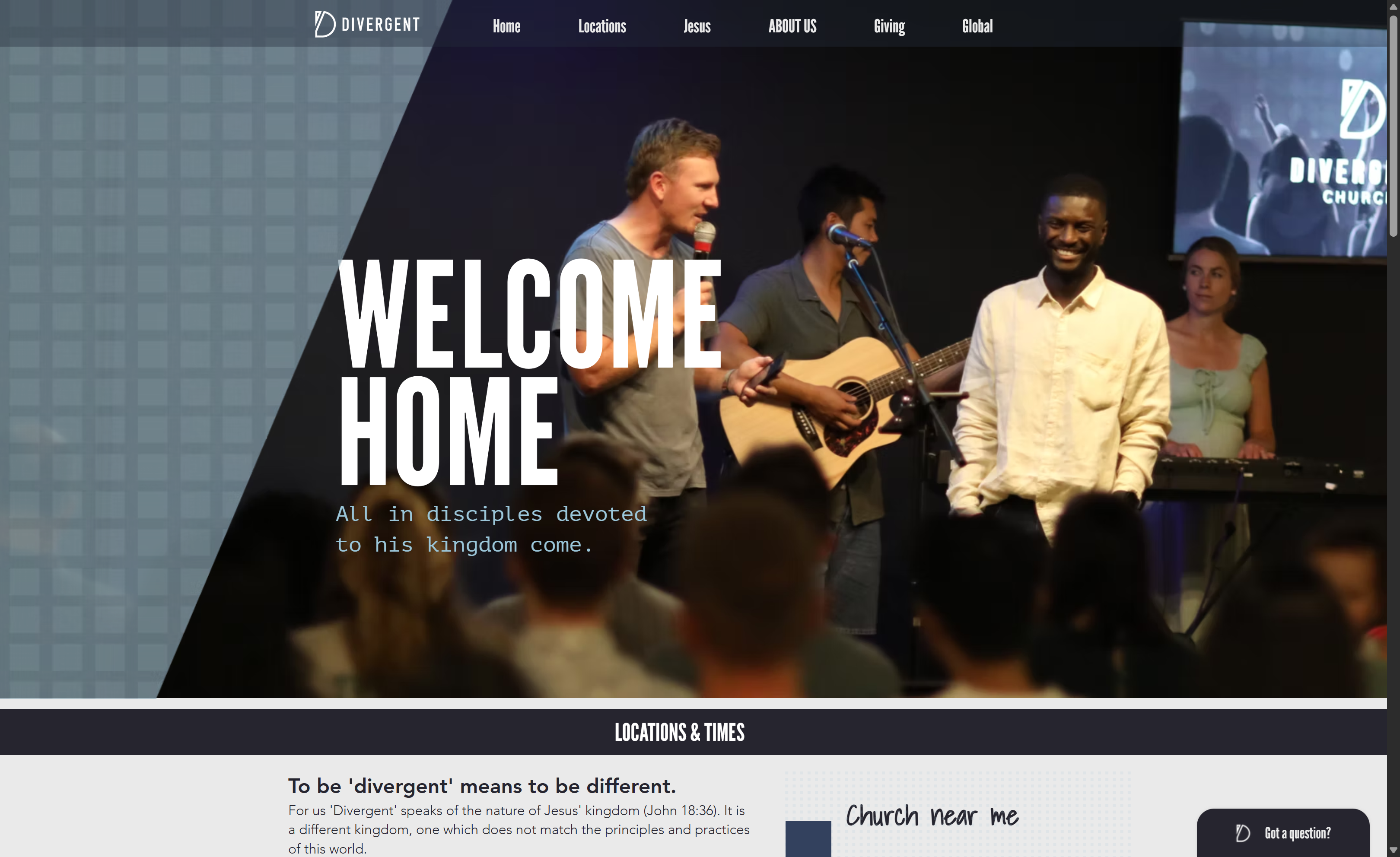
At Divergentchurch in Canberra, we believe the Church is most itself when it gathers people from every background around the person of Jesus. Our Discipleship Hub is designed to help you grow in faith within a community that takes both Scripture and cultural diversity seriously. Whether you are new to faith or looking for a community that reflects the full breadth of God’s kingdom, our Life Communities offer the kind of relational, cross-cultural belonging that transforms people from the inside out. If you are ready to explore what it means to follow Jesus in a genuinely inclusive community, we would love to have you with us.
FAQ
Why does church diversity matter theologically?
Church diversity is grounded in Revelation 7:9’s vision of a great multitude from every nation and language gathered before God. It reflects the reconciling work of Christ described in Ephesians 2:14, making it a theological imperative rather than a cultural preference.
How does diversity improve a church’s outreach?
Research shows that diverse organisations have a 70% higher chance of reaching new communities. For churches, this means a congregation that reflects its local demographics is far more equipped to engage and serve those same people with the gospel.
What is the difference between assimilation and accommodation in church?
Assimilation expects minority cultures to conform to the dominant church culture. Accommodation requires the majority culture to adjust its practices to create genuine space for others, and it is the only approach that produces authentic belonging.
How can a church avoid tokenism in its diversity efforts?
Tokenism is avoided by building diversity in relational settings first, particularly in small groups, rather than focusing solely on visible representation in leadership or on stage. Genuine inclusion is felt in everyday community life, not just in Sunday programming.
Does a homogenous church decline faster?
Research links misalignment with local demographics since the 1970s directly to church decline, suggesting that congregations failing to reflect their communities lose both credibility and growth over time.
Recommended
Comments