
Understanding church liturgy: what it reveals about faith

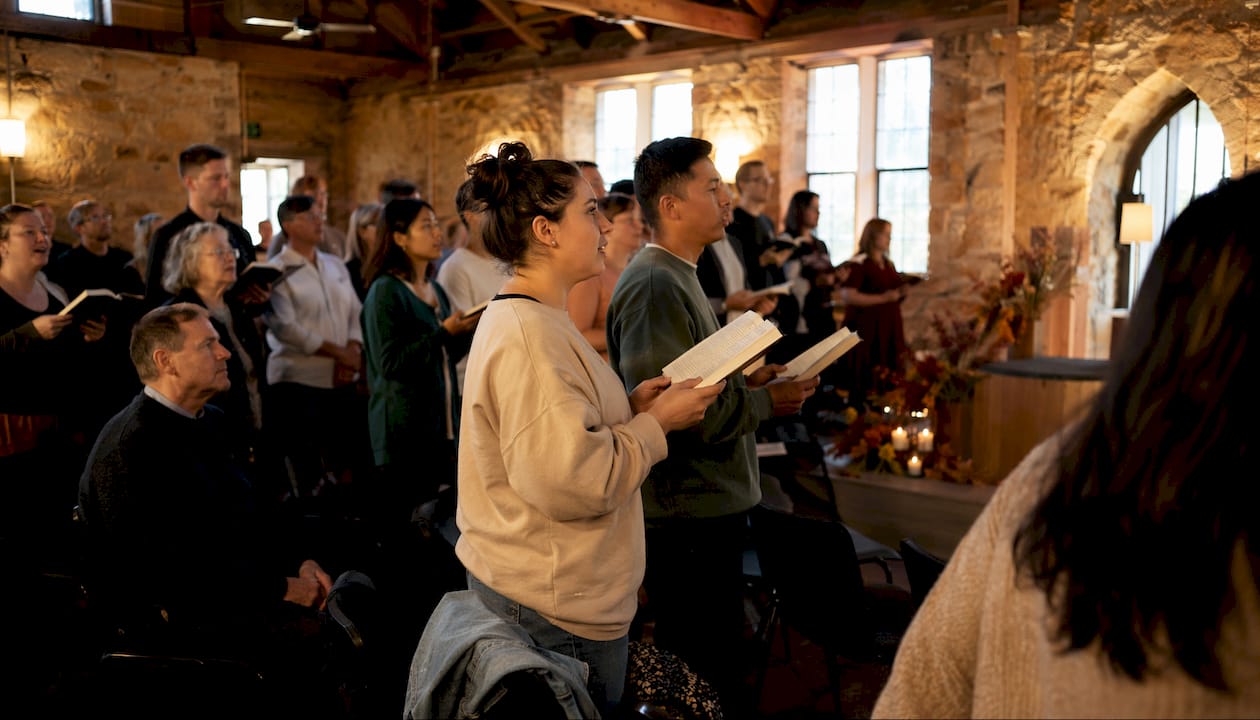
Church liturgy is defined as the structured, communal work of worship, a repeated and meaningful pattern where believers engage together through word, ritual, and symbol. The word itself comes from the Greek leitourgia, meaning “public work,” and that origin tells you something profound. Liturgy was never meant to be a private spiritual exercise. Understanding church liturgy means recognising it as a shared conversation between God and his people, one that reveals, with striking clarity, what a community truly values.
What is understanding church liturgy, and why does it matter?
Liturgy originates from the Greek meaning “public work” and describes a structured, repeatable pattern of worship involving the whole congregation. That definition matters because it shifts liturgy from something a minister performs to something a community does together. Most Christian denominations hold principal liturgical services on Sundays, though many also observe daily rhythms like the Liturgy of the Hours.
Every gathering has a liturgy, whether or not the community uses that word. A church that opens with three songs, a welcome, a sermon, and a closing prayer has a liturgy. The question is never whether you have one. The question is whether it is intentional. When a community shapes its gatherings deliberately, the liturgy becomes a living map of what that community holds valuable.
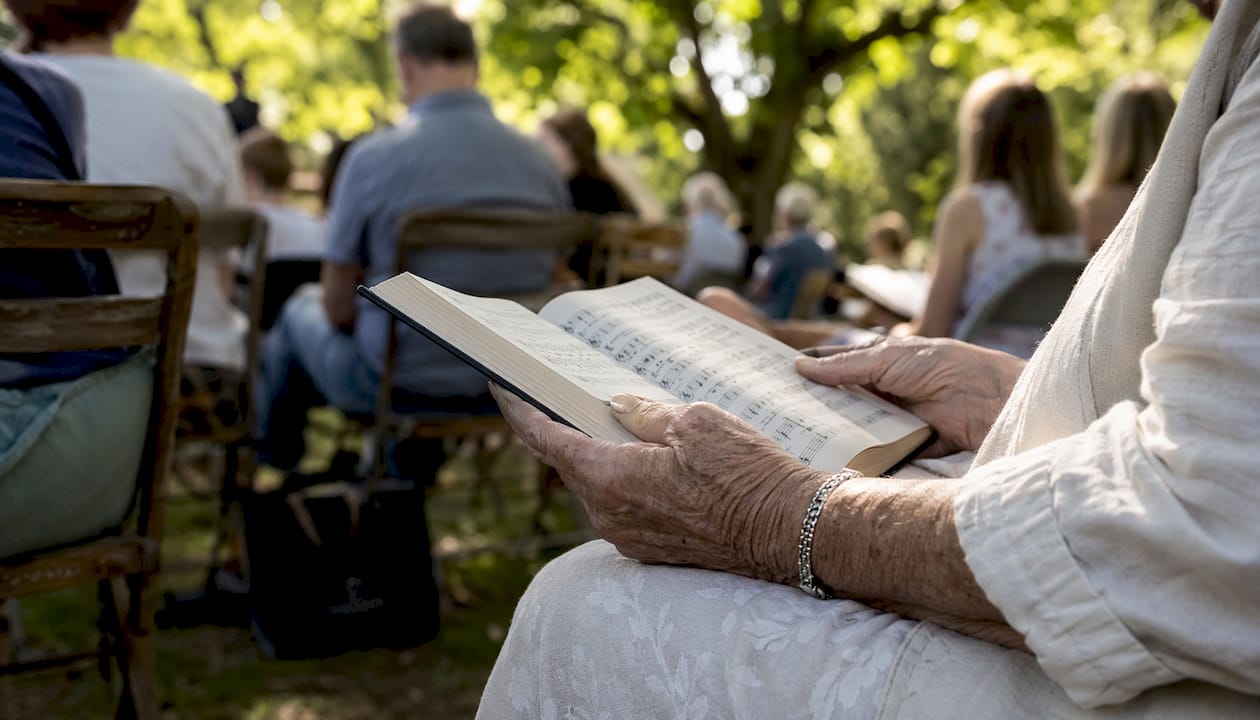
Liturgical worship is not a performance but a structured dialogue. God speaks through Scripture, and the congregation responds in prayer, confession, and praise. That back-and-forth is the heartbeat of every liturgical service, regardless of tradition.
What are the core elements of a church liturgy?
Most Christian liturgies organise their services around two primary movements. Many liturgies structure services into the Liturgy of the Word and the Liturgy of the Eucharist. The first half centres on Scripture reading, preaching, and corporate prayer. The second half moves into Communion, where the congregation responds to what it has received.
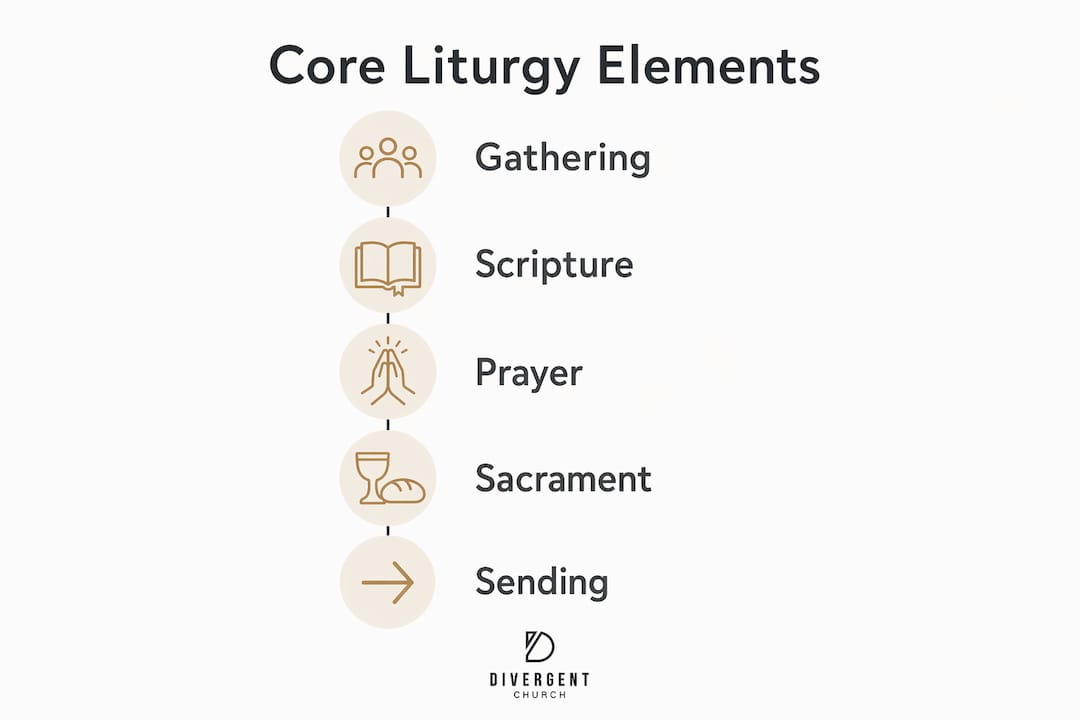
Beyond those two movements, a typical service includes several recurring elements:
Gathering and greeting — the community assembles and acknowledges God’s presence together.
Confession and assurance — sin is named honestly, and God’s forgiveness is proclaimed.
The creed — a shared statement of belief, such as the Apostles’ Creed, spoken in unison.
Scripture reading and sermon — God’s Word is read aloud and explained.
Prayers of intercession — the congregation prays for the world, the church, and one another.
Offering — a physical act of giving that reflects gratitude and trust.
Benediction — the community is sent out with a blessing.
Physical participation is woven through every one of these elements. Effective liturgy engages voice, memory, posture, hearing, and action in dialogical participation. That full-body engagement is not incidental. It is the point. Faith is formed through what you do with your body, not only what you think in your mind.
The liturgical calendar adds another layer. Liturgy extends beyond Sunday to a yearly cycle that immerses believers in Christ’s narrative, from Advent through Christmas, Lent, Easter, and Pentecost. Each season revisits Christ’s birth, death, and resurrection, reinforcing faith through ritual recurrence rather than isolated teaching moments.
Pro Tip: If you are new to a liturgical service, follow along with the order of service sheet rather than trying to understand every element at once. Familiarity grows with repetition, and that is precisely how liturgy is designed to work.
How do liturgical practices vary across Christian traditions?
Liturgy takes different shapes across traditions, yet the underlying structure remains recognisable. Liturgy is the overall structure or shared script, while rituals are specific ceremonies within that framework. Baptism and Communion are rituals that appear within the liturgy. Keeping that distinction clear helps when comparing traditions.
The table below shows how four major traditions approach their gatherings.
Tradition | Emphasis | Typical style |
Catholic | Eucharist as central act of worship | Formal, prescribed texts, priest-led |
Orthodox | Divine Liturgy with chant and rich symbolism | Ancient rites, incense, icons, congregational chant |
Protestant | Scripture and sermon as primary focus | Simplified order, congregational singing, responsive reading |
Evangelical | Emotional connection and Spirit-led encounter | Flexible order, contemporary music, extended preaching |
What unites these traditions is more significant than what divides them. All four gather the community, read Scripture, pray together, and send people out. The style differs. The substance does not. A healthy church community across any tradition will show these marks of shared, intentional worship.
Why is liturgy important for spiritual formation and community identity?
Liturgy forms people over time. Vatican II updated liturgical rites to be characterised by noble simplicity, enabling full, active participation by the congregation. That reform was grounded in a conviction that passive attendance produces passive faith. Engagement produces formation.
Repetition is the mechanism. When you confess the same creed week after week, you are not being bored into belief. You are training your memory, your affections, and your identity. The same is true of singing, of kneeling, of sharing bread and wine. Liturgy trains spiritual sensibility, helping believers recognise God’s grace in material signs like bread, wine, and water in worship. Those elements are not arbitrary. They are the church’s way of mediating grace through the physical world.
Consider what liturgy does for community identity:
It creates shared memory. A congregation that has sung the same doxology for decades carries a collective story.
It crosses generational lines. Children and grandparents participate in the same responses, building unity across age.
It anchors identity in Christ’s story. The liturgical year means your community’s calendar is shaped by Jesus, not by the commercial calendar.
It provides belonging. A visitor who knows the liturgy can walk into any church in that tradition and feel at home.
Pope Leo XIV describes liturgy as an antidote to the culture’s obsession with productivity, creating what he calls a “logic of gratuitousness” that regenerates the heart. That phrase is worth sitting with. Liturgy asks nothing of you except presence. You do not produce anything in a worship service. You receive.
“Liturgical rites and symbols reveal God’s presence, inviting believers into a rhythm inhabited by the Holy Spirit, pausing the relentless pace of modern life to recognise grace in the ordinary.” — Pope Leo XIV
Pro Tip: Try attending the same liturgical service for four consecutive weeks before forming an opinion. The meaning of liturgical elements often only becomes clear through repetition, not explanation.
The role of prayer in church is one of the clearest examples of this formation at work. Corporate prayer in a liturgical context teaches you to pray beyond your own needs, to intercede for others, and to use language shaped by Scripture rather than only personal feeling.
How does Divergentchurch shape its gatherings with intention?
Divergentchurch holds a clear conviction: every gathering has a liturgy, and that liturgy reveals what the community values. The way Divergentchurch shapes its services can change from season to season, but every element is chosen deliberately, seeking to reflect the teaching of Scripture and the shared life of the community.
Divergentchurch views each gathering’s liturgy as intentional, reflecting taught Scripture and communal values shaped by participation and openness to the Spirit. That means the order of a service is never accidental. When a song is placed before a reading, or a time of silence follows a confession, those choices carry theological weight.
Practically, this intentionality shows up in several ways:
Scripture shapes the structure. Readings, songs, and prayers are chosen to reinforce the same biblical theme, so the whole service speaks with one voice.
Participation is built in. Responsive readings, congregational prayer, and shared confession give every person a voice in the gathering, not just the person at the front.
Symbols are used with care. Bread, wine, water, and light are not decorative. They are chosen because they carry the weight of God’s story.
Flexibility serves depth, not novelty. The style of a gathering at Divergentchurch may shift, but the commitment to Scripture, community, and the presence of the Spirit does not.
The gathering extends into life. Liturgy at Divergentchurch is not contained to Sunday. It seeds the week with rhythms of prayer, Scripture, and service that go beyond Sunday into the city’s universities, workplaces, and neighbourhoods.
This approach reflects a broader truth about liturgy: it is not a rigid formula but a living expression of what a community believes. When you walk into a Divergentchurch gathering, the shape of the service is itself a statement of faith.
Pro Tip: Pay attention to why elements are placed where they are in a service. Ask a leader or pastor about the reasoning. That conversation will deepen your engagement with worship more than any book on liturgy.
Key takeaways
Liturgy is the communal work of worship that forms faith, builds identity, and reveals what a community values through every deliberate choice in its gatherings.
Point | Details |
Liturgy is communal, not personal | It is a structured dialogue between God and the gathered community, not a private spiritual exercise. |
Every church has a liturgy | The question is not whether you have one, but whether it is intentional and shaped by Scripture. |
Repetition forms faith | Repeated creeds, songs, and symbols train memory, affections, and identity over time. |
Traditions share a common structure | Catholic, Orthodox, Protestant, and Evangelical services all gather, read Scripture, pray, and send people out. |
Divergentchurch shapes gatherings deliberately | Every element reflects Scripture and community values, with flexibility in style but consistency in purpose. |
Liturgy as a language I had to learn
When I first started attending a liturgical service, I felt like a tourist in a country where I did not speak the language. Everyone around me seemed to know when to stand, when to kneel, and what to say. I was lost. What changed things for me was not a class or a book. It was showing up enough times that the words began to settle into my body.
That experience taught me something I now believe deeply: liturgy is a language, and like any language, it rewards patience. The people who dismiss liturgical worship as empty ritual are usually the ones who have only attended once or twice. They have heard the words without yet understanding the grammar.
What I find most compelling about liturgy is that it does not flatter you. It does not ask how you feel or adjust itself to your preferences. It places you inside a story that is larger than your own. That can feel confronting at first. Over time, it becomes the most freeing thing in the world. You are not the centre of the service. Christ is. And that reorientation, week after week, is quietly transformative.
Liturgy also binds you to believers across centuries. When you recite the Apostles’ Creed, you are saying the same words that Christians in the second century said. That continuity is not nostalgia. It is solidarity with the whole body of Christ across time. At Divergentchurch, we hold that sense of connection seriously, even as we express it in ways that speak to Canberra in 2026.
— Josh
Grow deeper in faith through Divergentchurch
Liturgy opens a door. What you do with that door is where discipleship begins.
Divergentchurch offers practical resources for people who want to move from understanding worship to living it. The Discipleship Hub is the best place to start, with guides, teaching, and tools for growing in faith beyond Sunday. If you want to go deeper in community, Life Communities are small groups where Scripture, prayer, and real relationship happen together. For those ready to take a next step, the participate page shows you how to get involved in the life of the church. Liturgy is not meant to be observed from a distance. It is meant to be lived.
FAQ
What does the word “liturgy” actually mean?
Liturgy comes from the Greek leitourgia, meaning “public work.” It describes a structured, repeatable pattern of worship that involves the whole congregation, not just the minister or priest.
Is liturgy only for Catholic or Orthodox churches?
No. Every church has a liturgy, including Evangelical and Pentecostal congregations. The term simply refers to the order and structure of a worship gathering, whether that is highly formal or deliberately flexible.
What is the difference between liturgy and ritual?
Liturgy is the overall structure of a worship service, while rituals are specific ceremonies within it. Baptism and Communion are rituals that occur inside the broader liturgical framework.
Why does liturgy repeat the same elements every week?
A predictable liturgical sequence fosters unity and belonging by enabling participation through designated responses. Repetition trains memory and affection, forming faith over time rather than through a single encounter.
How can I engage more meaningfully with liturgy?
Follow the order of service, pay attention to why each element is placed where it is, and attend consistently. Meaning in liturgy accumulates through repetition, not through a single explained visit.
Recommended
Comments